For healthcare administrators, executive directors, directors of nursing, and operations leaders.
Most healthcare facilities are already using a staffing agency. We all know the model already works.
The question is whether the partner you have chosen is built to support your facility the way it needs to be supported.
Labor makes up 56% of total hospital costs, according to the American Hospital Association’s 2025 Cost of Caring Report.
Hospitals spent over $51 billion on contract labor in 2024. That level of investment deserves a partner who delivers more than a confirmed shift.
The facilities that manage this well share a few things in common.
They have visibility into what they are spending and who is on their floor. They have clean records that hold up under review.
They have a partner who stays in the process after the placement is made. And they have someone to call when coverage falls through, not a ticket queue.
This article helps you evaluate your options and build a staffing strategy that supports your operations, your staff, and your patients.
Key Takeaways
- Staffing agencies are a core part of how most facilities operate. The right partner makes that relationship work harder for you.
- Agency markups run 25% to 100% above base pay. Understanding the full cost structure helps you make a smarter investment.
- Marketplaces give you access. Referrals build retention. A good agency provides compliance oversight, operational visibility, and support that neither can replace.
- A structured agency relationship reduces overtime, protects your compliance posture, and removes coordination work from your team.
- Facilities that invest in the right agency partnership get more predictable coverage, cleaner records, and a permanent staff that is not constantly absorbing gaps.
What a Strong Agency Partnership Looks Like
When the right agency relationship is in place, facilities feel it across the entire operation.
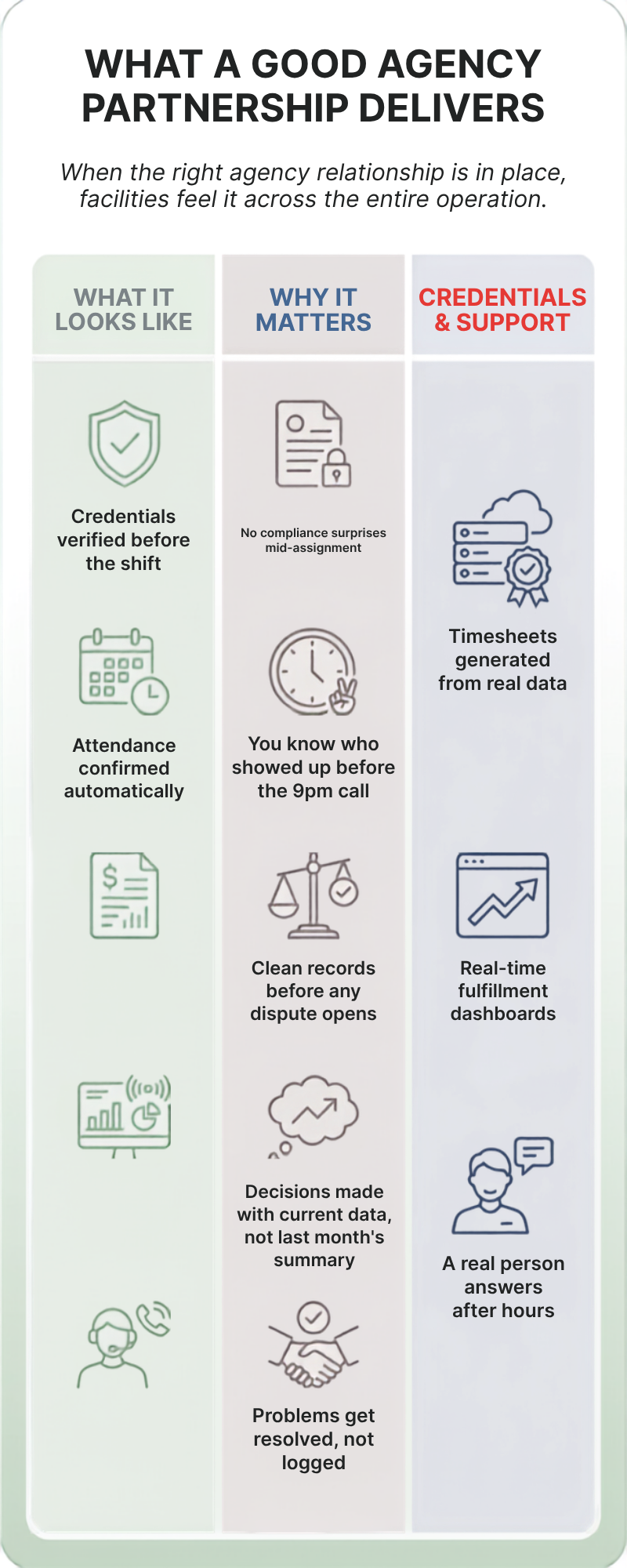
Coverage is more predictable. Credentials are cleared before a clinician walks in, so there are no compliance surprises mid-shift.
Attendance is confirmed automatically, so your team knows the floor is covered before the evening call.
Timesheets generate from real data, eliminating disputes over hours.
Administrators have a live view of fill rates, clinician reliability, and spend, so decisions are made with current information rather than last month’s summary.
When something comes up after hours, a real person who knows your facility picks up and handles it.
When evaluating any agency, the bill rate is only part of the picture.
The more important questions are what the relationship takes off your team’s plate and what visibility it gives you in return.
That is what sets a strong partner apart from a basic placement service.
Understanding What You Are Paying For
The bill rate is the starting point. It is not the full picture.
ShiftMed’s 2024 report found that hospitals consistently undercount what agency staffing costs them.
Beyond the base rate, markups, admin fees, and contract add-ons accumulate. Agency markups in healthcare run from 25% to 100% above base pay, with last-minute placements hitting the top of that range.
According to HFMA data cited by ShiftMed, 96% of hospital CFOs name labor expenses as their top financial pressure.
One open position costs a facility an average of $7,700, per Randstad US research.
That rises to $14,000 at three months vacant.
A well-structured agency relationship reduces reactive, last-minute placements. This is where premium costs are highest, and reduces the administrative time your team spends managing work the agency should be handling.
Most agencies provide a monthly summary. The facilities with the most control over labor costs are the ones with a live view of what is being spent now.
A structured agency relationship is an investment in cost control, not just coverage, and the facilities paying the most are often the ones with the least visibility into why.
Agency, Marketplace, or Referrals: Building the Right Mix
Each staffing source serves a different purpose. The key is matching the right tool to the right need.
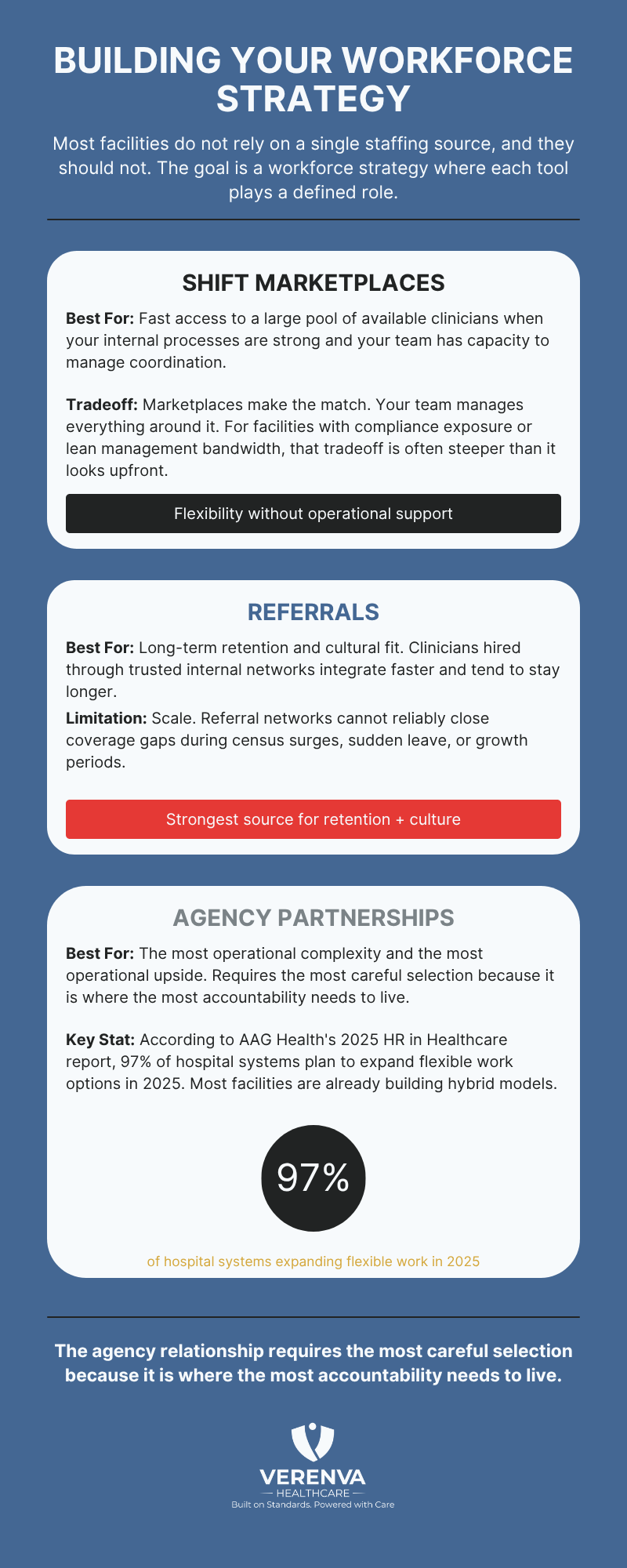
A staffing agency manages the operational work that comes with placing a clinician: credential verification, compliance tracking, attendance confirmation, timesheet management, and support when something changes.
For facilities managing ongoing vacancies, leave coverage, or census shifts, a capable agency keeps operations stable without placing that coordination burden on internal teams.
According to AAG Health’s 2025 HR in Healthcare report, 97% of hospital systems plan to expand flexible staffing in 2025.
The agency relationship carries the most compliance and operational weight in a hybrid model, and selecting it carefully is one of the most consequential decisions a facility leader makes.
A shift marketplace provides fast access to a large pool of available clinicians.
It works well when internal processes are strong and the team has capacity to manage coordination after the match.
For facilities where management bandwidth is limited, a marketplace can transfer more work onto internal staff than it removes.
Referrals remain one of the strongest sources for long-term retention and cultural fit.
Clinicians hired through trusted networks tend to stay longer and integrate faster.
They are not a reliable solution for urgent gaps or sudden demand, but as part of a broader strategy they are invaluable for building a stable core team.
Most facilities use all three. The agency relationship deserves the most scrutiny because it carries the most leverage over coverage continuity, compliance exposure, and team workload.
What to Ask Any Agency Before You Sign
A strong agency should be able to answer these questions clearly before you commit.
- How do you track credential expiration, and what does our facility see before a shift is confirmed?
- How do you verify the clinician arrived at the correct location and on time?
- What records does your system produce to support PBJ and CMS 2540-24 reporting?
- What does live visibility into fill rates and spending look like for our administrators?
- Who is available after hours, and what authority do they have to act?
- What is your process when a confirmed clinician needs to cancel?
The answers reveal whether you are building a partnership with an agency invested in your facility’s success, or a transactional arrangement where your team absorbs everything that falls through.
How Verenva Healthcare Supports Your Facility
Verenva Healthcare serves hospitals, long-term care facilities, rehabilitation centers, correctional facilities, and doctor’s offices across South Carolina and North Carolina.
Founded in 2018 by nurses who understood the floor, an engineer who built the systems to support it, and operators who knew what a reliable staffing partnership should look like.
Verenva Healthcare was built around one idea: accountability does not end when the shift is confirmed.
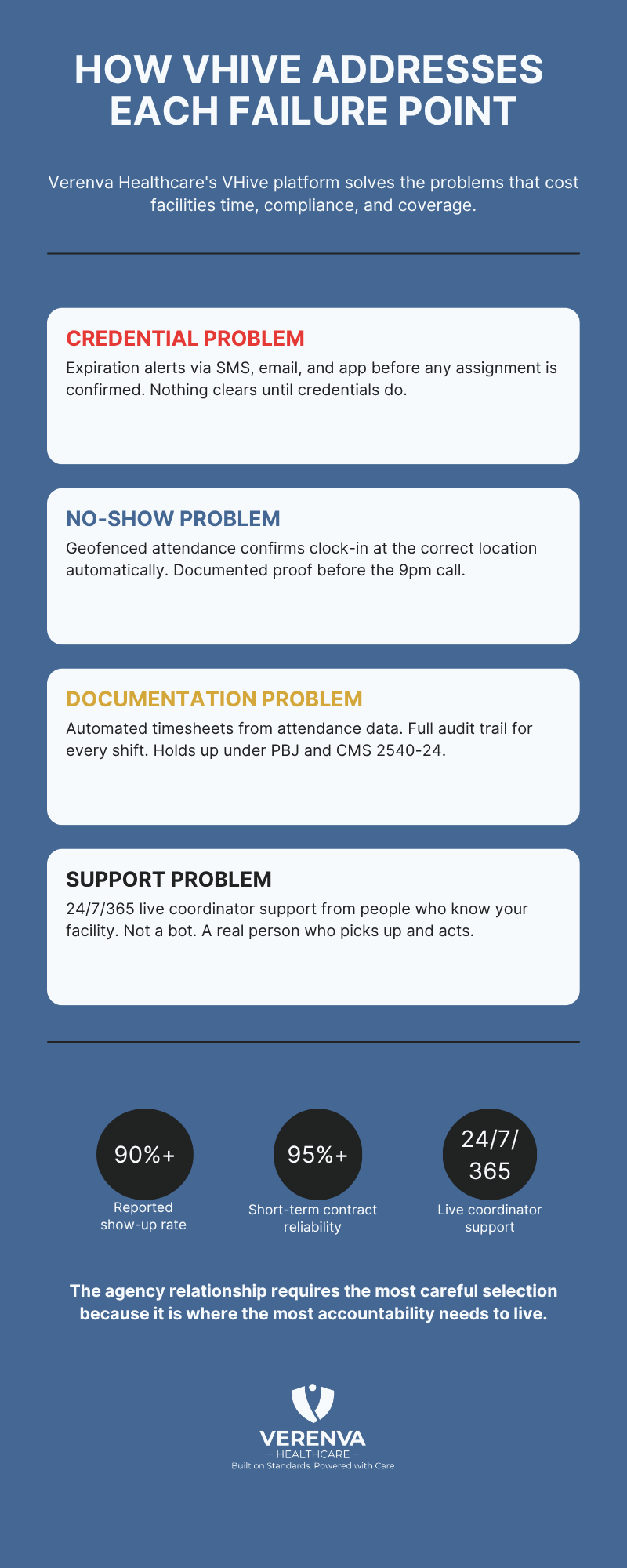
VHive gives facilities the visibility and operational support most agencies do not provide.
Credential alerts go out via SMS, email, and app before any shift is confirmed. Nothing clears until credentials do.
GPS-confirmed check-ins create documented proof of arrival automatically.
Auto-generated timesheets hold up under PBJ and CMS 2540-24 requirements.
Live KPI dashboards give administrators a real-time view of fill rates, clinician reliability, and staffing costs across every shift.
Every record is logged and available for any audit or review.
Behind the platform is 24/7/365 live coordinator support from people who already know each facility. Not a call center. A real person who picks up and acts.
Our reported show-up rate exceeds 90%. Short-term contract reliability exceeds 95%. When a clinician cancels, backup coverage is provided.
Facilities working with Verenva Healthcare report more predictable coverage, cleaner compliance records, and permanent staff who spend less time managing gaps and more time focused on care.
The Decision
The right agency partnership is one of the highest-leverage investments a facility can make.
It affects coverage continuity, staff stability, compliance posture, and the quality of care your residents and patients receive.
Choosing a partner based on bill rate alone leaves most of that value on the table. The facilities that get the most from their agency relationships chose a partner built for accountability, not just placement.
Verenva Healthcare is ready to be that partner.
Send us a message to get started.
